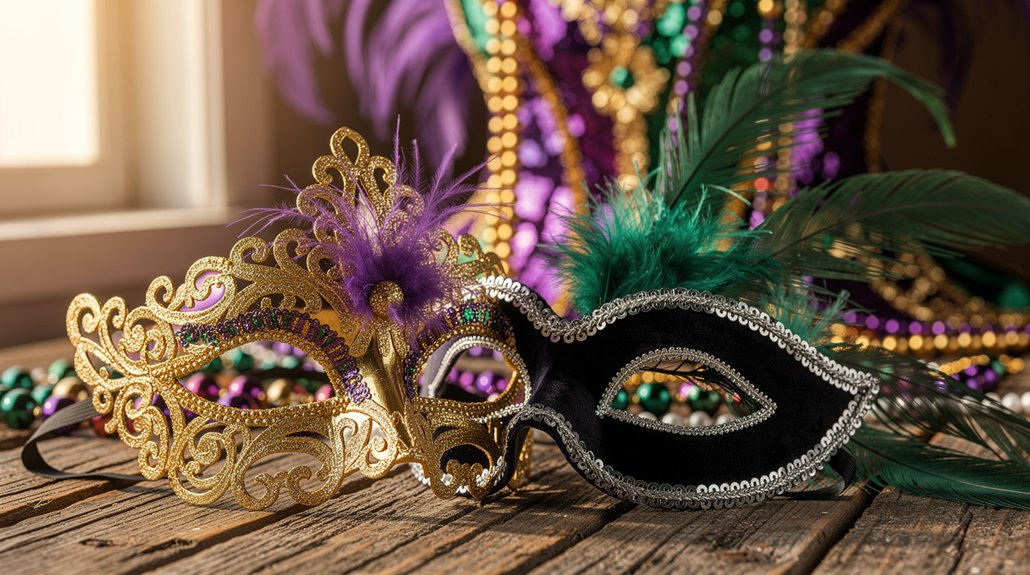
Mardi Gras masks are part costume and part tradition. For one day, a mask lets anyone be anyone. On the floats, a mask is more than a custom, because riders are required to cover their faces. If you're watching from the street, a mask is your choice. This guide explains what masks mean, what the rules are, and how to pick one you can wear all day.
This is a researched guide, not legal advice. Sources were checked on November 28, 2026, and Mardi Gras Day is February 9, 2027.
As an Amazon Associate I earn from qualifying purchases. Product links go to Amazon searches, so you can compare what's in stock.
Key Takeaways
- Masks let people set aside who they are for a day and join the party as equals.
- Float riders in New Orleans are required to wear masks or face paint.
- For people in the crowd, masks are welcome on Mardi Gras Day and are optional.
- Half masks are the easiest style to wear for hours.
- Take your mask off when a shop, a bank or a police officer asks you to.
Why People Wear Masks at Mardi Gras
A mask hides your face, and that was the point from the start. Behind a mask, a banker and a dockworker look the same. People could mix, dance and joke with anyone.
The Mardi Gras New Orleans site puts the modern custom simply: float riders are required to wear masks by law, and on Fat Tuesday everyone is free to wear them. The mask still stands for mystery and for a day off from your normal self.
That's why a krewe member's identity is often kept quiet. The person throwing you beads could be your neighbor or your boss. You're not supposed to know.
The Mask Rules in New Orleans
There are two sets of rules, one for riders and one for everyone else.
Riders. New Orleans & Company, the city's tourism office, lists it among its Mardi Gras facts: float riders are required by law to wear masks or face paint. Krewes take it seriously, and riders keep their masks on for the whole route.
The crowd. For parade watchers, a mask is optional. Smithsonian Magazine notes that Louisiana law against wearing masks in public is set aside on Mardi Gras Day in New Orleans. That's the day you'll see the most masks and full costumes on the street.
A few plain manners go with it:
- Take your mask off when you walk into a shop, a bank or a restaurant if asked.
- Lift it when a police officer or a security guard speaks to you.
- Don't use a mask as cover for bad behavior.
Laws and their details can change. If you plan to wear a full face mask in public on any other day, check the current city and state rules first.
Where Mardi Gras Masks Came From
Masking is much older than New Orleans. Carnival seasons in Europe, and the masked balls of Venice and France, set the pattern. French settlers brought the custom to Louisiana.
It wasn't always welcome. Smithsonian's history of the tradition says masked balls were allowed again in 1823, and that wearing a mask in the street was made legal in New Orleans in 1827. Masks have been part of the city's Carnival ever since.
Classic Mask Styles
Most masks you'll see fall into a few types.
- Half mask. Covers the eyes and the top of the nose. This is the easiest to wear, eat and talk in. Search for Mardi Gras half masks.
- Feather mask. A half mask with a tall spray of feathers on one side or across the top. It's the classic photo mask.
- Mask on a stick. You hold it up to your face. It's good for a party or a ball, and less handy at a parade, where you need your hands.
- Metal filigree mask. A thin, laser-cut metal mask that looks like lace. Metal masquerade masks are light and dressy.
- Full face mask. Covers the whole face. It's the hardest to wear for long, and it gets warm.
- Jester mask. A face with a pointed, belled hat. It's more of a decoration than something to wear.
For a group, a bulk pack of Mardi Gras masks costs little and makes a party feel like one.
How to Choose and Wear a Mask Comfortably
A mask that hurts ends up in your bag by noon. Check these before you buy.
- Fit. It should sit on the bridge of your nose without pinching.
- Eye holes. You need to see to the sides, not just straight ahead.
- Ties. Ribbon ties adjust better than thin elastic, and they don't pull your hair.
- Weight. Lighter is better. Heavy feathers and gems drag a mask down.
- Glasses. If you wear them, pick a mask on a stick or one that clips to your frames.
Wear it at home for half an hour first. Bring a few hairpins to hold the ties in place. If you plan to wear a mask at a parade, pick a half mask you can push up onto your forehead between floats.
Skip masks on babies and small children. Face paint or a hat is safer for them.

What Purple, Green and Gold Mean on a Mask
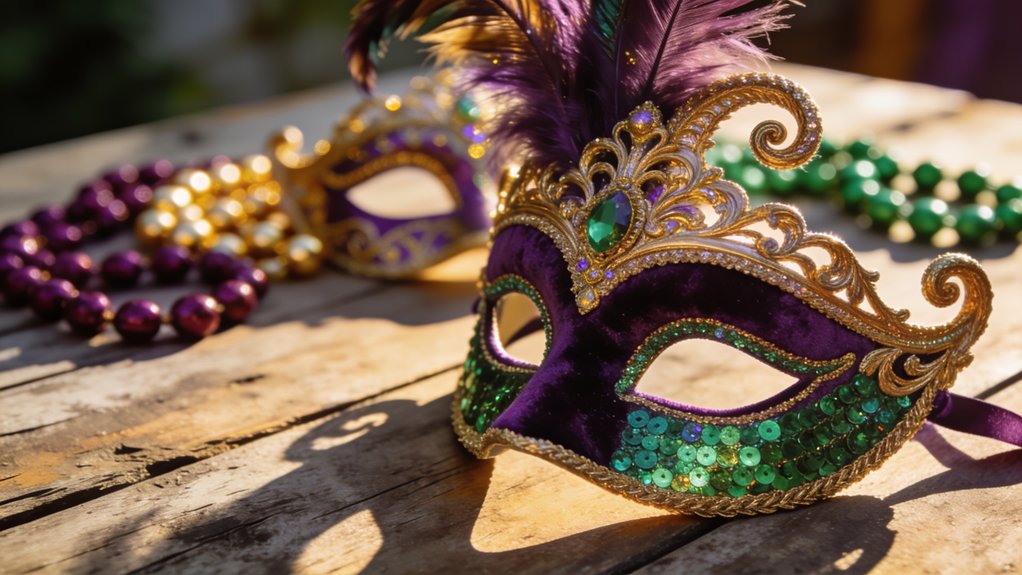
Most Mardi Gras masks come in the three Carnival colors. The Rex Organization says its 1892 parade theme gave them their meanings: purple for justice, green for faith and gold for power.
You don't have to wear all three. A black and gold mask looks sharp with any outfit. A white or silver mask suits a ball. For a parade, anything bright works. Read more in our guide to Mardi Gras colors and bead meanings.
Masks as Decorations and Keepsakes
Masks do double duty at home.
- Lay one on each plate at a party, as a favor.
- Hang a large one on the front door or above a mantel.
- Tuck a few into a Mardi Gras tree.
- Frame a favorite one after the season.
See our guides to Mardi Gras table decorations, door decorations and tree decorations for ideas. For the rest of your look, start with our Mardi Gras outfit ideas for every budget.
Images in this guide are AI-generated illustrations of masks. They are not photos of real masks for sale.
Frequently Asked Questions
Do I have to wear a mask to a Mardi Gras parade?
No. Masks are optional for people watching. Only the riders on the floats are required to cover their faces.
Why do float riders have to wear masks?
It keeps the old tradition of mystery, and it's the rule. The city's tourism office lists it as law that riders wear masks or face paint.
Can I wear a mask before Mardi Gras Day?
Simple masks are common at parties, balls and private events all season. For wearing a face-covering mask on public streets, Mardi Gras Day is the day it's allowed, so check current rules for other days.
What kind of mask is best for a parade?
A light half mask with ribbon ties. You can see, breathe, eat and talk, and you can slide it up when you need a clear view of the floats.
Can I bring a mask home on a plane?
Yes. Pack it flat between soft clothes, or carry it in your personal bag. Feathers bend, so give a feathered mask its own space or a small box.