
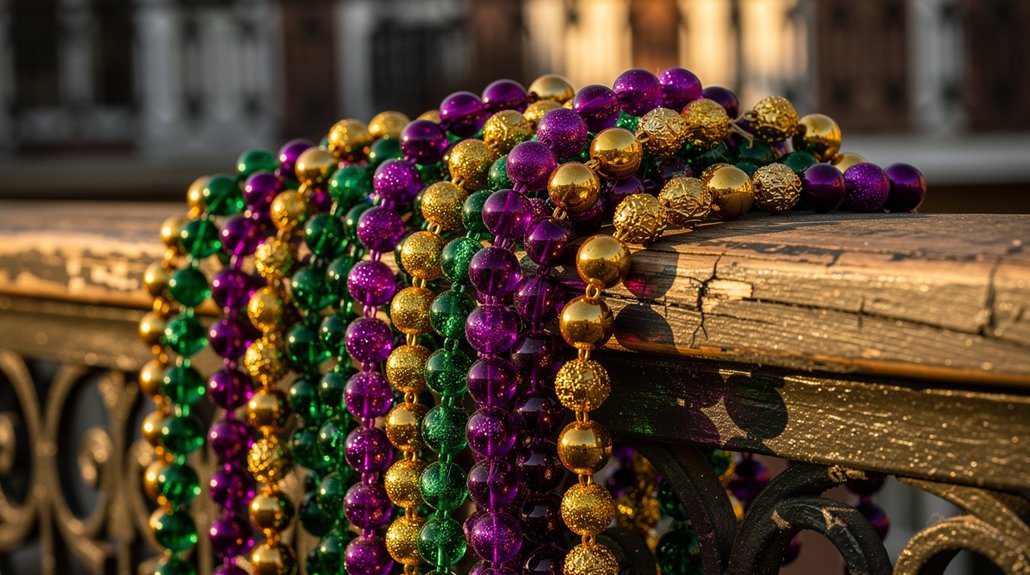
Mardi Gras beads come in three main colors, and each one has a meaning. Purple stands for justice, green stands for faith, and gold stands for power. Those meanings trace back to Rex, the krewe whose king is called the King of Carnival. The full story is a little messier than the three-word answer, and it's a good one to know before you catch your first strand.
This is a researched guide. Sources were checked on November 28, 2026, and Mardi Gras Day is February 9, 2027.
As an Amazon Associate I earn from qualifying purchases. Product links go to Amazon searches, so you can compare what's in stock.
Key Takeaways
- Purple beads stand for justice, green for faith and gold for power.
- The colors come from Rex, which has used them since its first parade in 1872.
- The meanings were added later, by Rex's 1892 parade theme.
- Nobody recorded why those three colors were picked in the first place.
- Beads became a parade favorite after Rex's riders threw them in 1921.
What Each Mardi Gras Bead Color Means
Here's the answer most people come for.
| Color | Meaning |
|---|---|
| Purple | Justice |
| Green | Faith |
| Gold | Power |
The Rex Organization puts it plainly. Its 1892 parade had the theme "The Symbolism of Colors," and that parade suggested that purple, green and gold stood for justice, faith and power. The meanings stuck, and they've been repeated at every Carnival since.
So when a rider throws you a purple strand, you can say you caught a little justice. That line works at any parade party.
Where the Colors Came From
The colors are older than their meanings. Rex has used purple, green and gold since its founding, and its first parade rolled in 1872. The group's own history says the first meaning its founders had in mind was never made clear.
That gap has filled up with stories. One popular tale ties the colors to a Russian grand duke who visited that year. The Mardi Gras New Orleans site walks through what's true and what's legend about the colors, and it lands on the same two facts: the colors are purple, green and gold, and the 1892 parade gave them meaning.
What we can say for sure is short. Rex picked the colors, the city adopted them, and the meanings came about twenty years later.
Why Krewes Throw Beads at All
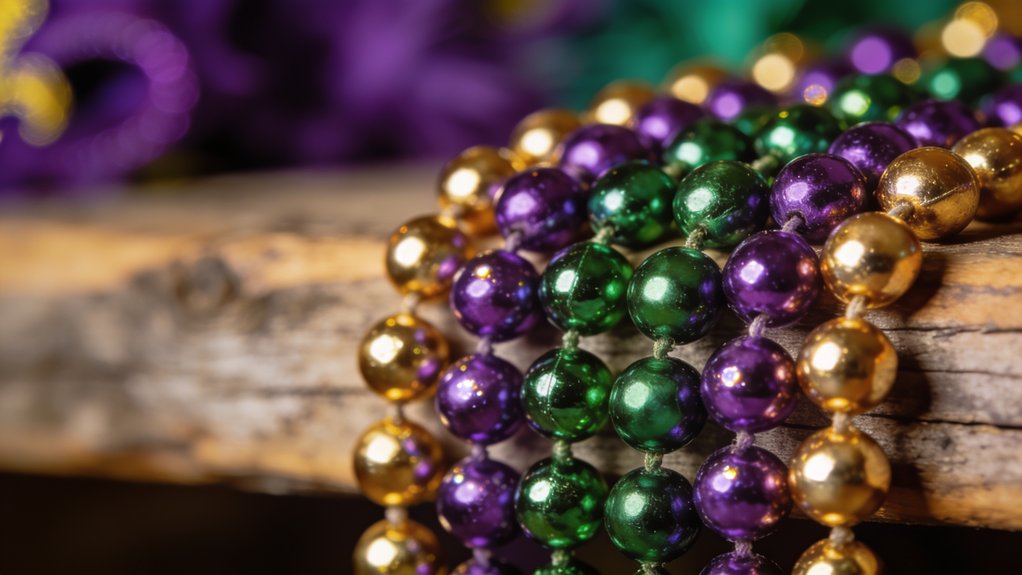
Tossing small gifts to the crowd is an old Carnival habit. Beads joined the party in a big way about a century ago. The Louisiana Endowment for the Humanities notes that beads were popularized by Rex in 1921, during the krewe's fiftieth year.
Those early beads were glass, and many came from the region once called Czechoslovakia. The Historic New Orleans Collection says strings of hand-strung glass beads quickly became the souvenir people wanted. Plastic took over in the 1960s because it cost less and broke less.
Today riders pay for their own throws, and they throw a lot of them. Catching a strand is the simplest way to take part in the parade. Want to get better at it? Read our tips on how to get beads at Mardi Gras.
Do Other Bead Colors Mean Anything?
Not in any official way. You'll catch red, blue, pink, silver and pearl-white strands too. Those are just for fun and variety.
A few kinds of beads do carry extra weight with locals:
- Krewe beads. Many krewes throw strands with their own medallion or logo. These are the ones people keep.
- Long or large beads. Riders save the big strands for people who catch their eye.
- Glass beads. A few groups hand out glass strands as a nod to the old days. See our guide to glass Mardi Gras beads.
The meaning of a strand often has more to do with who threw it than with its color.
Where You'll See Purple, Green and Gold
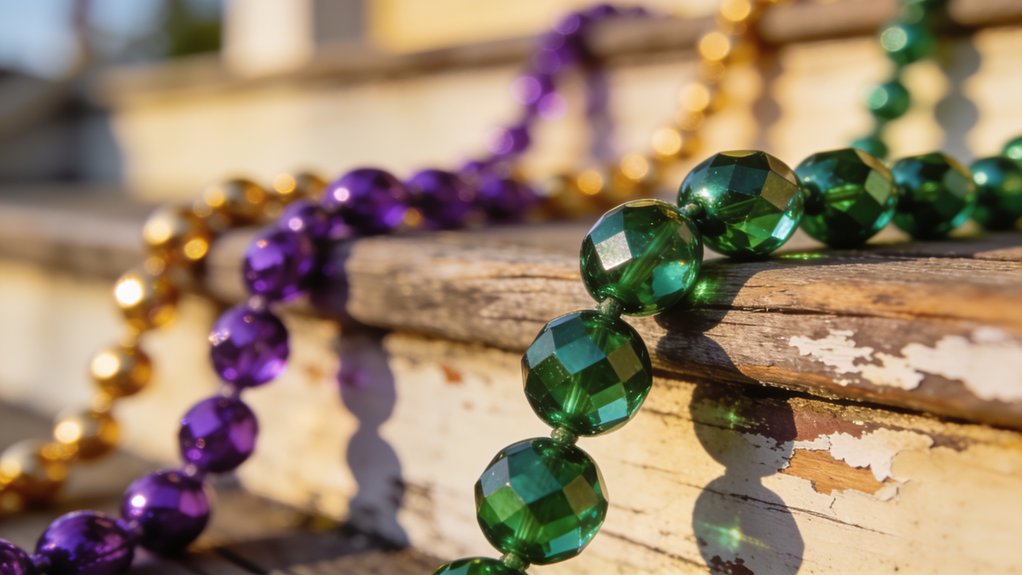
Once you know the colors, you'll spot them all over town from January 6 until Mardi Gras Day.
- On floats, flags and house fronts along the parade routes
- On king cake, as three bands of colored sugar
- On shirts, masks, wigs and costumes in the crowd
- On wreaths, porch bunting and door decorations
You can bring the colors home, too. A bag of purple, green and gold beads covers a party table or a classroom. Mardi Gras flags and bunting do the same for a porch.
Curious about the cake? Our guide explains what a king cake is and why it has a baby inside.
What to Do With Your Beads After Mardi Gras
A good parade day can leave you with pounds of beads. You have better choices than the trash.
- Keep the good ones. Krewe medallion beads make a nice souvenir. A shadow box frame turns a few strands into wall art.
- Reuse them. Save a bag for next year's party, a school project or a wreath.
- Recycle them. Groups in New Orleans collect used beads each year and sort them for reuse. Look for collection bins along the routes and around town after the season.
Never pick up beads from the street to wear, and don't put any beads in your mouth. They've been on the ground, and small parts can be a choking risk for little kids.
Images in this guide are AI-generated illustrations of beads. They are not photos of a real parade.
Frequently Asked Questions
Do krewes ever change the bead colors?
The three Carnival colors stay the same, but krewes add their own. Many throw strands in their own krewe colors, with a medallion that shows the krewe's name and the year's theme. Collectors go after those.
Do Mardi Gras beads have meanings beyond purple, green and gold?
No official ones. Other colors are for variety. What makes a strand special is its size, its medallion, or the krewe that threw it.
Why are beads thrown from the floats?
It's the krewe's gift to the crowd. Riders buy their own throws and toss them to people along the route. Rex made bead throwing popular in 1921, and it has been part of every parade since.
Can I buy beads in just one color?
Yes. Beads are sold by the dozen and by the case in single colors and in mixed sets. Single colors are handy for school colors, team colors or a themed party.
Were Mardi Gras beads always plastic?
No. The early beads were glass, and many were made in Czechoslovakia. Plastic strands replaced them in the 1960s, since plastic was cheaper and tougher. Old glass strands are now collected, and our guide to vintage Mardi Gras glass beads explains how to spot them.