
Is the French Quarter or CBD better for a first visit?
Planning a first trip to New Orleans involves a trade-off between the desire to be in the center of activity and the need for a safe, quiet place to recharge. The Strategic Proximity model evaluates accommodations based on three factors: walking distance to Jackson Square, access to the Regional Transit Authority (RTA) streetcar network, and historical safety data from the New Orleans Police Department (NOPD).
New Orleans is a compact city, but its neighborhood boundaries are sharp. Staying just four blocks outside the French Quarter can mean the difference between a restful night and the constant noise of Bourbon Street. For a first-timer, the goal is to minimize transit friction. According to current RTA system maps, the CBD serves as the city's primary transit hub, where the St. Charles, Canal, and Rampart-Loyola streetcar lines converge. This makes it the most logistically sound choice for those who want to see the Garden District and Mid-City without relying on expensive rideshares. The concentration of hotels in the CBD also ensures a higher density of well-lit corridors compared to more residential areas.
French Quarter: Staying in the Historic Heart
The French Quarter is the reason most people visit New Orleans. Staying here means being steps away from the St. Louis Cathedral, the French Market, and the iconic beignets of Café du Monde. The primary advantage is total walkability; once visitors arrive, they likely will not need a vehicle for a significant portion of their sightseeing. However, first-time visitors must weigh this against the neighborhood's density and noise levels. The French Quarter is a 24-hour district, and the sound of street performers and nightlife can carry through historic building walls.
If choosing the Quarter, looking for hotels on the "Lower" side (between St. Philip Street and Esplanade Avenue) is a practical strategy. This section is significantly quieter than the blocks surrounding Bourbon Street. Visitors should also note that the City of New Orleans has been undergoing a massive French Quarter Infrastructure Project. As of mid-2026, the Sewerage and Water Board of New Orleans (SWBNO) reports that subsurface utility work is nearing completion, but localized sidewalk improvements are scheduled through late fall 2026. Verifying if a specific block is affected by active construction is a recommended step for any traveler.
CBD and Warehouse District: The Modern Transit Hub
The Central Business District (CBD) and the Arts/Warehouse District have become the preferred hubs for savvy first-time travelers. These areas feature renovated industrial warehouses and sleek high-rises that offer amenities often missing in historic Quarter properties, such as rooftop pools and soundproofed windows. From the intersection of Poydras Street and St. Charles Avenue, a visitor can reach Jackson Square in a short walk of under twenty minutes. This allows for easy access to the historic core during the day while providing a buffer from the crowds at night.
Logistically, the CBD is a primary choice for efficiency. It is the only neighborhood where there is immediate access to every major streetcar line. The New Orleans RTA maintains its central transfer points here, allowing visitors to hop on the St. Charles line for a standard single-ride fare to see the mansions of Uptown or take the Canal Street line to Mid-City. For those arriving from the airport, the 202 Airport Express bus drops off in the CBD, providing a direct, low-cost link to the city center.
Garden District: Quiet Charm and Streetcar Access
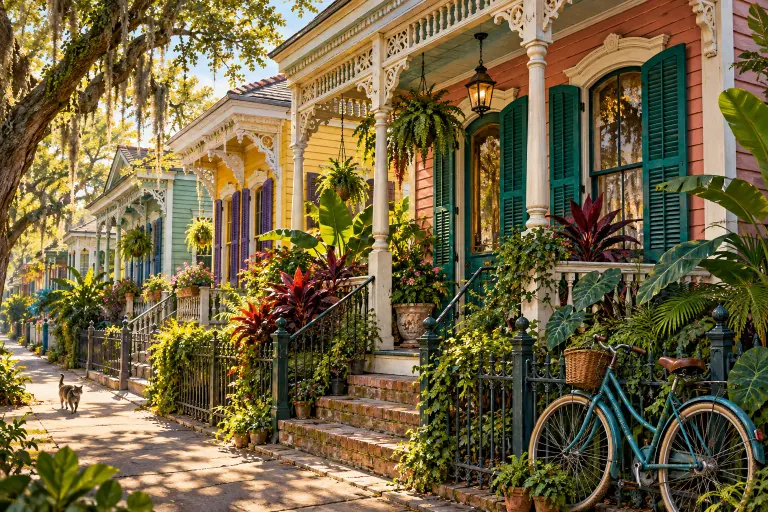
For visitors who prefer oak-lined avenues and Victorian mansions, the Garden District is a premier choice. Located about two miles upriver from the French Quarter, this neighborhood offers a residential feel distinct from the more tourist-heavy zones. The primary artery here is St. Charles Avenue, home to the world's oldest continuously operating streetcar line. While the Garden District is not walkable to the French Quarter, the transit link is iconic and efficient. A three-day Jazzy Pass, which costs the standard multi-day pass rate, allows for unlimited rides, making the 20-minute streetcar journey into the city center part of the sightseeing experience.
Safety and Walkability Comparison
Safety is a common consideration for first-time visitors. According to the NOPD Q1 2026 report, the city has seen a historic decrease in violent crime incidents over the last three years. In the 8th District, which covers the French Quarter and CBD, police solve rates for violent crimes have reached well above the national average due to increased camera integration and foot patrols. Despite these improvements, situational awareness is required. It is recommended that all first-time visitors download the Le Pass app, which provides real-time tracking for all RTA vehicles. When walking between neighborhoods, sticking to well-lit corridors like Royal Street or St. Charles Avenue is a standard safety practice.
Planning tip: When choosing a hotel, utilize the "last-mile" rule. Check the walking distance not just to the French Quarter, but to the nearest streetcar stop or well-lit thoroughfare. A hotel that appears close on a map may be isolated by construction or poorly lit side streets, which can impact the ease of travel after dark.
Choosing Your Ideal New Orleans Base
The choice of neighborhood should align with primary travel goals. If the trip is a short stay focused on main landmarks without a car, the French Quarter is a logical choice. If modern comforts and easy transit are valued, the CBD is a professional alternative. For those on a slower-paced cultural tour, the Garden District provides a picturesque environment. Regardless of the chosen location, booking lodging at least three to four months in advance is recommended.
A five-minute way to decide
If the comparison above still leaves you split, run this short exercise. Write down the five things you would be genuinely disappointed to miss — not a long wish list, the top five. Drop them on a map. If four cluster in and around the Quarter, stay in or beside the Quarter and stop deliberating. If they scatter from the Garden District to City Park, pick the base with the best transit spokes — usually the CBD — because no neighborhood wins a scattered itinerary on walkability alone. Then sanity-check the result against your sleep tolerance and budget for your exact dates. Five minutes, one decision, and the rest of the planning gets easier because every later choice inherits a fixed home base.
Sources and update notes
This guide was compiled using independent research and official data from the following primary sources: